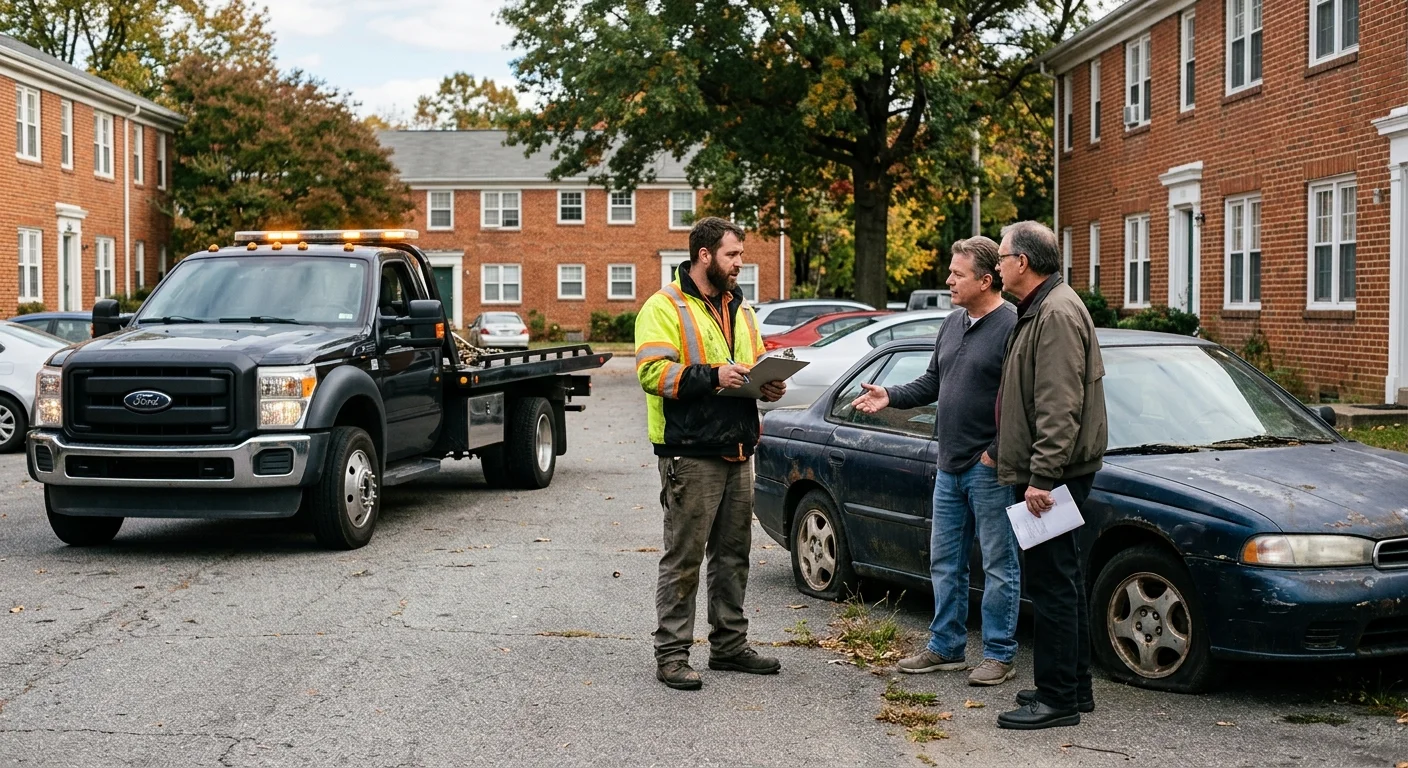
For anyone searching “richmond junk car removal,” start by confirming two things: you can transfer the vehicle, and the apartment manager will allow pickup access. Then give the operator accurate details about the car, parking space, destination, and paperwork. That preparation helps prevent a wasted trip or a blocked pickup.
What authorizes “richmond junk car removal” from your lot?
Start with your connection to the vehicle. Your name on the Virginia title gives an operator and receiving facility a clear place to begin. If the title shows someone else, don’t schedule removal until the operator explains what authorization it will accept.
Permission to move the car and permission to enter the property are separate issues. Read the parking and vehicle-removal sections of your lease. Then ask the apartment manager whether a tow vehicle can enter the lot and reach your space.
Get the manager’s answer in writing when possible. A short email can document the approved entrance, pickup location, and access instructions. If the property uses a gate, ask how the operator should enter. If your space sits inside a parking deck, confirm any posted clearance restrictions before booking.
Don’t treat an unfamiliar or abandoned vehicle as your property. A resident can report it, but that doesn’t establish the right to transfer it to a processor. Our guide to abandoned vehicle removal in Richmond explains the separate government notice and disposal pathway.
A manager arranging an involuntary removal also follows a different process. Learn more about private property towing if the vehicle belongs to someone else or is being removed for a parking violation. That isn’t the same transaction as an owner voluntarily junking a car.
When the lease and manager don’t provide a clear answer, pause. Ask the manager who controls the lot and what written approval is needed for entry.
Bring proof of ownership and the correct Virginia paperwork
Gather the title before arranging pickup. Virginia’s standard disposition path lets an owner sign the title over to a licensed demolisher or scrap metal processor. The owner may instead complete a Vehicle Removal Certificate, Form VSA 40.
The Virginia DMV Vehicle Disposition FAQ describes VSA 40 as the standard form for most transfers to demolishers or scrap metal processors. The receiving business doesn’t have to obtain a title in its own name. After demolition, it handles the required DMV cancellation and disposition reporting.
Ask the receiving facility which option applies before the vehicle moves. Don’t sign blank paperwork or guess which document it wants. The towing operator may transport the car, while a different business handles its final disposition.
A missing title doesn’t make the paperwork disappear. Virginia owners can request a replacement title with Form VSA 67. DMV allows the application online or in person with the registration card and a driver’s license. If several owners appear on the title, one may apply. A substitute title voids earlier titles.
Virginia plates remain with the owner, not the vehicle. DMV directs owners to surrender them immediately after a sale, junking, or when the vehicle is no longer operated. Surrender can be completed online, in person, or by mail with Form FMS 210. The owner must also notify DMV after a sale or transfer, though the verified state guidance doesn’t provide a numbered deadline.
For a fuller paperwork walkthrough, read how to junk a car in Virginia.
Describe the parking space and the car’s condition
A non-running car in an open surface lot is different from one inside a tight garage. Give the operator enough detail to evaluate the pickup before arriving. Include the apartment address, building location, space number, and planned entrance.
Describe the vehicle without guessing about the mechanical problem. Useful details include:
- Whether the car rolls, steers, and brakes
- Whether all tires are attached and inflated
- Whether the keys are available
- Whether the steering wheel or transmission is locked
- Whether the vehicle faces into or away from the space
- Whether another vehicle blocks its front or rear
- Whether the space sits near a wall, curb, tree, or dumpster
- Whether you see leaking fluid or loose bodywork
Photos can show more than a long explanation. Take one from the front, one from the rear, and one showing the wider parking area. Include the route from the lot entrance when access looks narrow.
Richmond locations can create very different pickup conditions. A courtyard behind an apartment in the Fan won’t resemble an open lot in Manchester. A garage near Shockoe Bottom may require different access planning than a surface space along Broad Street.
Don’t move the car into a travel lane to make pickup easier. Leave it where the apartment manager has authorized it to remain. Tell the operator if the position changes before arrival.
The junk car and abandoned vehicle removal service page explains how Quick Tow Richmond connects callers with independent operators. Those operators contract with and bill vehicle owners directly.
Clear apartment access before the pickup
Contact the property manager before confirming the appointment. Ask whether the operator needs a gate code, parking pass, office check-in, or manager escort. These aren’t universal Richmond rules. Each property can give you its current access instructions.
Also ask where the towing vehicle may stop. The operator needs a lawful path to the parked car and a route back out. Mention low branches, sharp turns, speed humps, parked delivery vehicles, or a narrow fire lane when you see them.
If the manager wants the car moved to a different space first, tell them it doesn’t run. Don’t agree to push, steer, or reposition it without knowing whether that can be done safely. Instead, relay the request to the operator and ask what information is needed.
Expired registration creates a narrow legal distinction for apartment residents. Under Virginia’s towing laws, a resident’s vehicle in a multifamily-dwelling lot must receive written notice on the vehicle at least 48 hours before an involuntary tow for expired registration or inspection. That protection applies to those specific reasons and that specific type of property. It isn’t a general waiting period for every apartment tow.
That rule doesn’t replace the owner’s need to coordinate a voluntary pickup. If you’re asking an operator to remove your own vehicle, confirm access directly with management.
Save the manager’s written instructions until the car has left. If office staff changes during the day, you’ll still have the approved entrance and pickup location available.
Set the destination and get the full charge first
Decide where the car is going before scheduling its removal. It might be transported to a licensed demolisher, a scrap metal processor, or another destination you select. Confirm that the destination will accept the vehicle and the paperwork you have.
Give both businesses the same vehicle details. Ask the receiving facility what must arrive with the car. Ask whether you need to be present and whether documents must be signed before pickup. If an answer isn’t clear, don’t assume the towing operator and processor follow identical procedures.
Request the complete towing charge before agreeing. Ask for the total with mileage included. Explain the apartment access, vehicle condition, and parking position so the operator can account for the actual job.
Quick Tow Richmond doesn’t set the independent operator’s total. The operator contracts with you and bills you directly. Ask which payment methods it accepts and when payment is due.
Don’t use a legal ceiling as a quote for this requested removal. Richmond’s local hookup ceiling and Virginia’s statewide ceiling govern nonconsensual private-property towing. They don’t establish the charge for an owner-requested junk car transport.
Keep the transport charge separate from any agreement with the destination. Ask whether the receiving business charges for acceptance, offers payment for the vehicle, or has another arrangement. Get that answer directly from the business before the car leaves.
Finally, confirm the destination name and address with the operator. A vehicle sent to the wrong facility can create another towing and paperwork problem. Save the operator’s terms, the destination’s instructions, and your ownership documents together.
When to call us
When a non-running car must leave an apartment lot, call after confirming ownership, manager access, and the destination. Quick Tow Richmond’s recorded line takes calls 24/7, plays a recording notice, and connects callers with independent licensed operators who contract with and bill owners directly. Call us at (804) 701-6752.