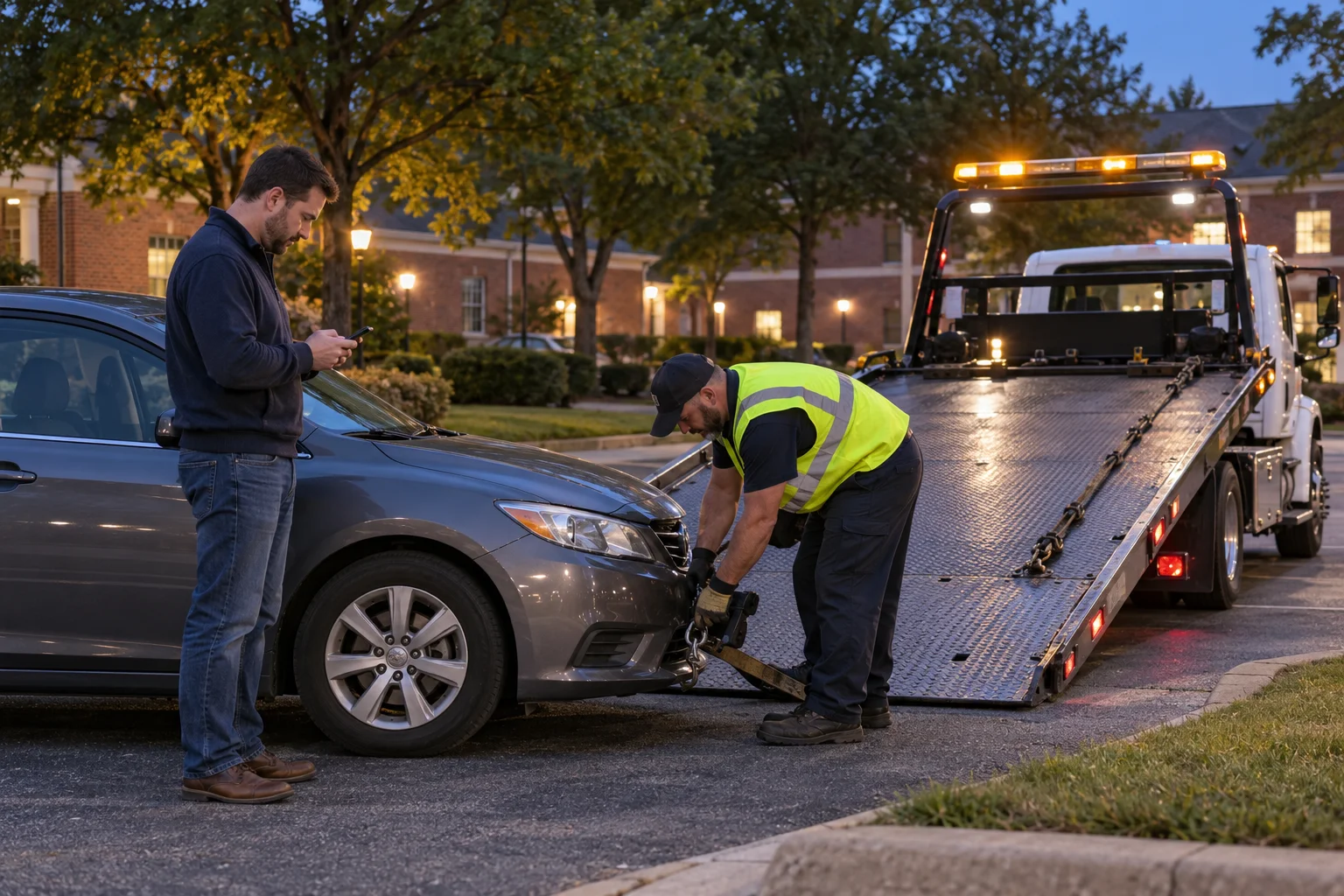
For 24/7 roadside assistance in chesterfield, first decide whether the problem can be fixed where the car sits. A jump start, tire change, fuel delivery, or lockout may call for roadside help. If the car still can’t move safely, arrange a tow instead.
Quick Tow Richmond takes calls through a recorded line at any hour. A recording notice plays before you leave your message. We then match requests with independent operators who contract with and bill drivers directly.
24/7 roadside assistance in chesterfield starts with clear details
Start with the location shown on your phone. Give the street, nearest intersection, business name, or visible landmark. If you’re near Route 10 or an interstate interchange, include your direction of travel.
Parking lots need more detail after dark. Name the entrance you used and the part of the property where the car sits. Mention a nearby storefront, building, or parking row when possible. Don’t depend on a business sign being visible from the road.
Next, describe the problem without diagnosing it. Useful descriptions include:
- The engine clicks but doesn’t start.
- The lights work, but the engine stays silent.
- One tire is flat.
- The fuel gauge is empty.
- The keys are locked inside.
- The car starts, then stops again.
Tell the operator whether the vehicle is in a travel lane, on a shoulder, inside a garage, or behind a gate. Mention low ceilings, narrow turns, locked entrances, steep slopes, or damaged wheels. These details help the operator decide whether roadside service is practical.
Vehicle details matter too. Give the make, model, and approximate model year. Say whether it’s a passenger car, pickup, motorcycle, van, or larger vehicle. If it’s all-wheel drive, electric, lowered, heavily loaded, or unable to roll, mention that before accepting service.
Our roadside assistance service page explains the referral process. If you’re elsewhere along Southside after dark, our guide to a breakdown after hours in Midlothian covers that separate situation.
When roadside help may be enough
Roadside help makes sense when one limited problem keeps an otherwise usable car from moving. The goal is to solve that immediate problem without transporting the vehicle.
A weak battery may only need a jump. Still, a successful jump doesn’t prove the charging system is healthy. Keep watching the warning lights and how the engine runs. If the car dies again or won’t stay running, towing becomes the safer choice.
A flat tire may be handled where the car sits when the spare and required tools are available. The location also needs enough working room. A damaged wheel, missing spare, multiple flat tires, or unsafe roadside position can change that decision.
Fuel delivery may help when the gauge reached empty and there’s no other known problem. Tell the operator what fuel the vehicle requires. Don’t guess if you’re uncertain. Check the fuel-door label or owner’s manual when available.
A lockout is another roadside problem, but confirm that the referred operator handles it. Share whether a child, vulnerable person, or animal is inside. Contact emergency services when there’s immediate danger rather than waiting for ordinary roadside service.
Drivers stranded on covered interstate routes may also encounter VDOT’s Safety Service Patrol. Its free services include jump starts, tire changes, fuel delivery, radiator water, and help arranging a tow. Richmond-area coverage includes I-95, I-64, and I-295.
The patrol isn’t a repair shop or towing company. Its role is roadside safety and incident management. Use 511 Virginia to check current traffic and incident information before making decisions from a safe location.
When the vehicle needs a tow instead
A tow becomes the better fit when roadside help can’t return the vehicle to safe operation. The same applies when trying another jump, adding fuel, or changing a tire could make the situation worse.
Arrange towing when the engine won’t remain running after a jump. A tow also fits when there’s visible crash damage, fluid beneath the vehicle, smoke, a damaged wheel, steering trouble, or a car that can’t roll normally. Don’t ask an operator to perform mechanical repairs that belong at a shop.
Location can settle the decision. A simple problem in a quiet parking space differs from the same problem beside moving interstate traffic. VDOT’s overnight Richmond-area patrol route covers I-95 between the I-295 interchange at mile 84 and Route 10 at mile 61. The patrol can help move a disabled vehicle from danger and assist with arranging a tow, but it doesn’t replace a towing operator.
If the vehicle requires transport, review our emergency towing service. Describe any collision damage, locked wheels, missing keys, low clearance, or inability to shift into neutral. The operator needs those facts before determining what equipment fits.
Don’t drive solely because the engine restarted. Warning lights, overheating, damaged tires, steering problems, or repeated stalling can signal that the car isn’t ready for the road. Tell the operator what happened, then ask whether roadside service or towing matches the condition you described.
The decision is practical: roadside help addresses a limited obstacle. Towing moves a vehicle that still can’t travel safely under its own power.
Confirm access at the destination
Choosing a destination is part of arranging an after-hours tow. A shop that’s open during the day may not accept vehicles overnight. Its parking area may also have a locked gate, limited space, or rules about unattended drop-offs.
Call the destination before service begins when possible. Ask whether it accepts after-hours deliveries and where the operator should leave the vehicle. Confirm how keys should be handled. Don’t leave keys in an unapproved location.
If nobody answers, don’t assume the property is accessible. Ask about another destination, such as your home or a location you know can receive the vehicle. The independent operator may have practical options, but the final destination still needs permission and workable access.
Give the exact address, not only a shop name. Similar business names can appear in different parts of the Richmond metro. Confirm whether the destination is in Chesterfield County, the City of Richmond, or another locality. That distinction affects the route and total distance.
Access details matter at the pickup point too. A disabled car in an open lot near Chesterfield Courthouse presents a different job from one inside a covered garage. Low clearance, tight ramps, gate codes, and narrow turns can limit which vehicle can reach it. Our separate guide explains what to share for towing from a Chesterfield parking deck.
Remove personal items you’ll need before the vehicle leaves. Take your house keys, medicine, work equipment, identification, and charging cables. Check the cabin and trunk while access is simple. Keep the destination’s instructions and the operator’s information available until delivery is complete.
Ask for the complete charge before service starts
Ask the independent operator for the complete charge before agreeing to service. Describe the location, vehicle, problem, access limits, and destination first. An incomplete description can produce a quote that doesn’t cover the actual job.
Confirm whether the amount includes mileage. Ask what could change the total, such as additional distance, restricted access, special loading needs, or a change from roadside help to towing. If the vehicle doesn’t start after an attempted jump, ask for the towing total before authorizing the next step.
Roadside assistance and towing are different services. Don’t assume the charge for one automatically includes the other. If an operator attempts roadside help and then recommends towing, request a clear breakdown of both parts.
Quick Tow Richmond is a referral service. We don’t perform the work, set the operator’s total, or control arrival times. The independent operator contracts with you and bills you directly.
Virginia’s statewide towing ceiling doesn’t set the price for a tow you request. The $210 ceiling under Va. Code § 46.2-1233.1 applies to the hookup and initial towing fee for a passenger vehicle removed without consent from private property. Chesterfield-specific towing prices could not be confirmed from the approved sources, so ask the operator for the complete total.
Before agreeing, repeat the pickup point, destination, vehicle condition, and quoted service. Save any written estimate or service message you receive. Clear details help prevent confusion when roadside assistance turns into after hours towing in Chesterfield.
When to call us
Call when a disabled vehicle needs roadside help or a licensed towing pro in Chesterfield. The recorded line takes calls day or night, and Quick Tow Richmond can refer your request to an independent operator. Call us at (804) 701-6752.