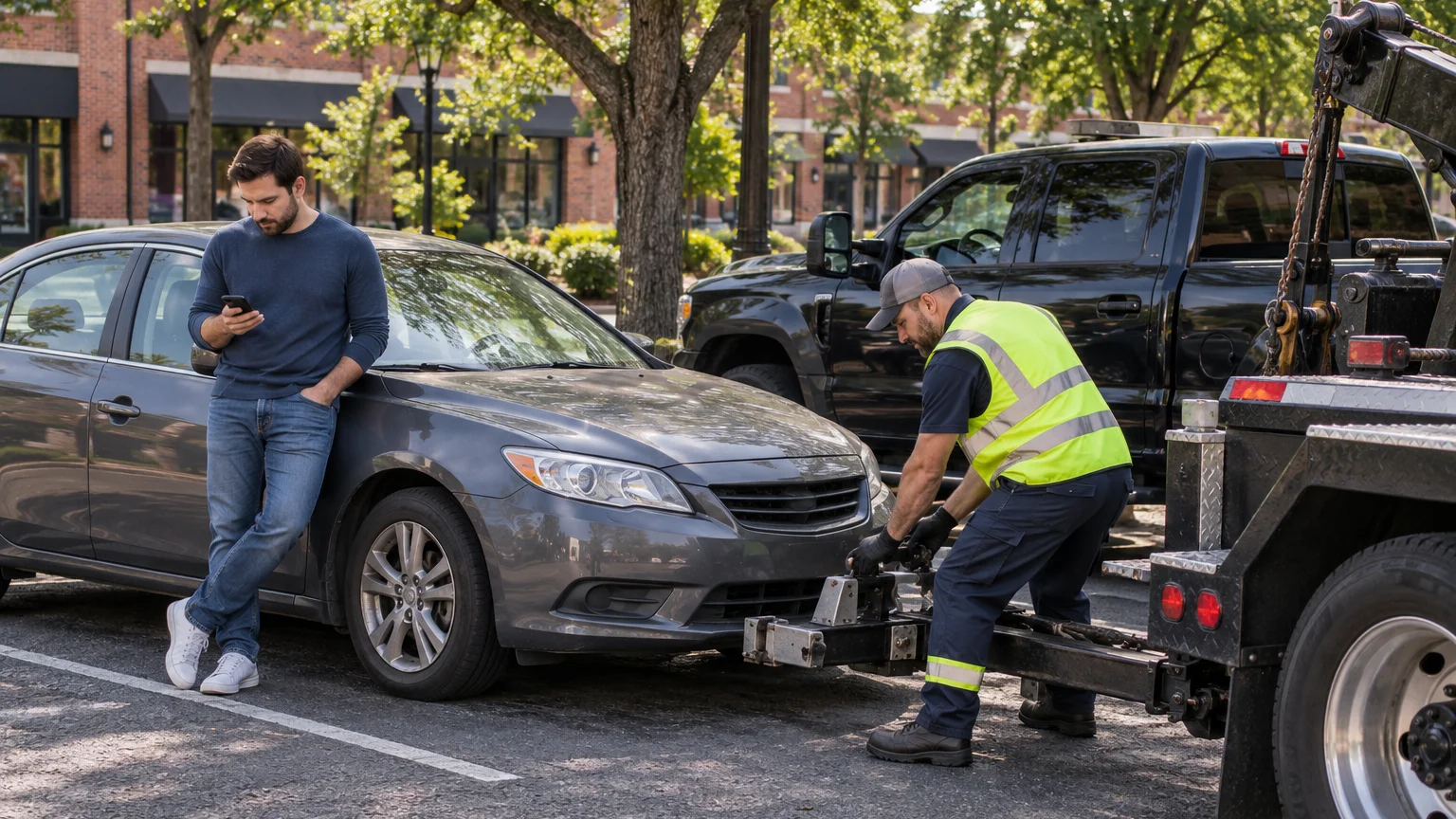
A parking-lot breakdown usually starts with one decision: roadside help or a tow. For richmond roadside assistance, share your exact location and describe what the car is doing. An independent operator can then discuss the suitable next step and the complete charge.
A parking lot is different from an interstate shoulder. You may have several entrances, rows, decks, or loading areas around you. The operator needs enough detail to reach the correct side of the property.
Share the exact lot and access point for richmond roadside assistance
Start with the property name and street. Then narrow your location inside the lot. A row marker, storefront, garage level, or nearby entrance can save confusion.
Richmond Metro isn’t one uniform service area. A surface lot near VCU differs from a garage in Shockoe Bottom. A shopping-center lot in Short Pump isn’t the same as a property in Chesterfield. Give both the locality and the property name. Don’t rely on “Richmond” alone.
Describe the entrance the operator should use. Some properties have separate entrances from different streets. Others have gates, ticket arms, loading docks, or one-way lanes. Mention any height restriction you can see. Don’t guess at the clearance.
Your message should include:
- The property or business name
- The full street address shown on your map
- Your parking row, level, or space
- The closest entrance or storefront
- Your car’s color, make, and model
- Any gate, ticket, or access issue
- Whether another vehicle can reach the front or side
Drop a location pin if your phone allows it. Keep the written details too. A pin can land on the wrong side of a large property.
Quick Tow Richmond’s recorded line takes calls at any hour. A recording notice plays before your message is recorded and transcribed. We refer requests to independent operators, who contract with and bill drivers directly. Our roadside assistance service page explains that referral process.
Describe what stopped the car
Tell the operator what happened immediately before the car stopped. Small details help separate a simple roadside request from a likely tow.
For a no-start problem, describe the sounds and dashboard behavior. Say whether the engine turns over, clicks, or stays silent. Mention whether the lights still work. If someone already tried a jump, say what changed afterward. A car that still won’t start after a jump may need transport rather than another attempt.
For a flat tire, say which tire is affected. Note visible wheel damage or a second low tire. Also mention whether the car has a usable spare. Don’t assume the spare is ready merely because it’s stored in the vehicle. Our guide to roadside help or towing after a flat explains the decision in more detail.
For an empty tank, provide the fuel type if you know it. For a lockout, explain where the keys are and whether anyone or any animal remains inside. Don’t attempt to force a door or window while waiting.
Also report smoke, leaking fluid, collision damage, unusual smells, or a wheel sitting at an odd angle. Those details may change the equipment or service being discussed.
Avoid diagnosing the car with certainty. Describe what you can see, hear, and smell. The operator can use those observations when discussing the next step.
When help at the vehicle may be enough
Roadside help may fit when the problem appears limited and the car remains safely accessible. Common requests include a jump start, changing a flat tire, fuel delivery, or help with keys locked inside.
That doesn’t mean every problem can be resolved in the parking space. A jump may not keep the engine running. A spare may be missing, damaged, or unsuitable. The wheel itself may have damage. Delivered fuel may not resolve a separate starting problem. A lockout may also require a different service approach based on the vehicle.
Parking position matters too. Tell the operator if the car faces a wall, sits beside a curb, or occupies a tight garage corner. Note whether cars are parked closely on both sides. These facts affect access even when the original problem seems simple.
Before agreeing to roadside service, ask what happens if that first attempt doesn’t restore mobility. Find out whether a separate tow would require a new charge. Ask whether the operator can provide both services or would need another arrangement.
Stay accurate about the symptoms. “The battery is dead” is a diagnosis. “The lights come on, but the engine only clicks” is a useful observation. That distinction helps the operator understand what you know and what remains uncertain.
If the car starts, pause before leaving. Check the dashboard and listen for unusual sounds. Don’t treat a successful jump or tire change as proof that every underlying problem is resolved.
When the car may need a tow
A tow may be the better fit when roadside help can’t return the vehicle to normal movement. It may also fit when visible damage makes another attempt at the parking space a poor choice.
Examples include a car that won’t stay running after a jump, a damaged wheel, multiple flat tires, collision damage, or a steering problem. A vehicle that can’t roll or steer normally may require different towing equipment. Describe those limits before an operator accepts the request.
Decide where the car should go before calling. You might choose a repair shop, dealership, home, or another lawful destination. Confirm that the destination can receive the vehicle. Don’t assume a closed shop has an accessible drop area or accepts unattended vehicles.
A parking deck needs extra attention. Share the garage level, entrance, turns, ramps, and posted clearance. Tight corners or low overhead space can affect which vehicle can reach you. Surface lots can also present obstacles such as curbs, landscaped islands, gates, and narrow fire lanes.
If roadside help has already failed, tell the towing operator exactly what was attempted. That information helps prevent repeating the same step.
Quick Tow Richmond can refer a towing request through its emergency towing service. The independent operator handles the towing agreement, service, and billing. We don’t own the dispatched truck, set the operator’s total, or perform the tow ourselves.
Confirm the complete charge before service starts
Ask for the full expected charge before authorizing service. The total may depend on the requested work, vehicle condition, access, distance, destination, and any additional service discussed after arrival.
Start by confirming whether the quote covers roadside help, towing, or both. If towing may follow an unsuccessful roadside attempt, ask how each part would be billed. Request the total with mileage included. Also ask what could change that amount.
Don’t confuse a driver-requested service with a nonconsensual private-property tow. Richmond caps the hookup fee for a nonconsensual private-property tow at $195. Virginia’s statewide ceiling for that same type of passenger-car tow is $210. Those are legal ceilings, not quotes for roadside help or a tow you request. The Code of Virginia towing chapter provides the statewide framework.
Repeat the destination address before service begins. A shop with several locations can create an expensive misunderstanding. Confirm whether the vehicle will be left with a person, placed in an approved drop area, or taken somewhere else.
Ask who will bill you and which payment methods that operator accepts. Quick Tow Richmond is the referral service. The independent operator contracts with you and bills you directly.
Save any written quote or message. Request an itemized receipt after service. If the scope changes, pause and ask for the revised total before approving additional work.
When to call us
Call when a parking-lot problem may need roadside help or a licensed towing pro. Leave the exact lot, access point, symptoms, vehicle details, and intended destination on our recorded line. Call us at (804) 701-6752.