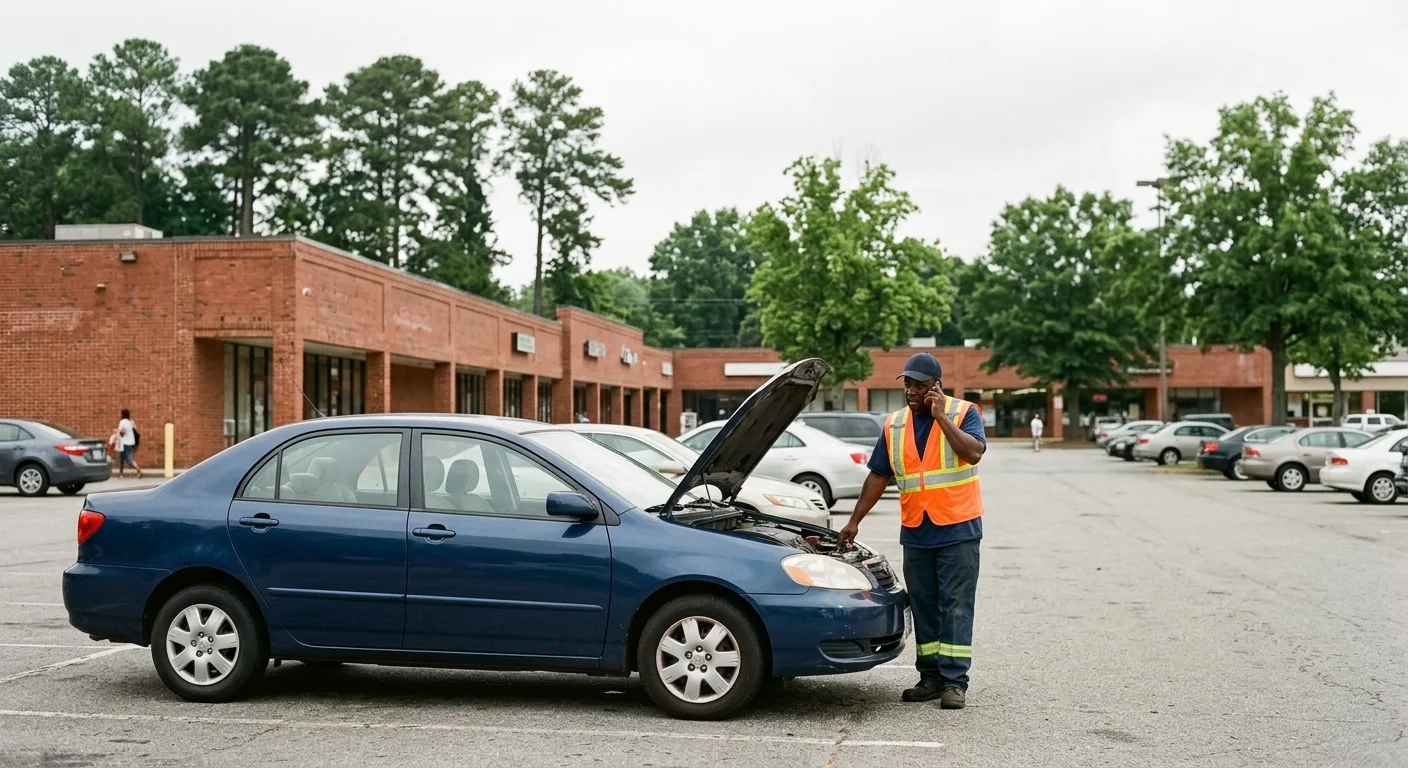
A dead battery in a Southside parking lot doesn’t require joining a roadside club. If you’re asking, “can you get roadside assistance without being a member,” the answer is yes. You can check coverage you already carry, use VDOT’s interstate patrol where available, or arrange a single job with an independent operator.
The right route depends on your location and the vehicle’s condition. Start with the option that fits the breakdown in front of you.
Check coverage you may already have: can you get roadside assistance without being a member?
Start with your auto policy before buying another benefit. Towing and roadside coverage are optional policy add-ons in Virginia. They aren’t part of the mandatory liability and uninsured or underinsured motorist coverages.
That means this is a policy-level question. Virginia law doesn’t set the roadside services, approval process, or benefits included in your individual policy. Check your policy documents or contact your insurer directly.
Ask whether your current policy covers this specific incident. Confirm how help must be requested and whether approval is needed first. You’ll also want to know what documentation the insurer requires. Don’t assume that seeing the word “towing” means every roadside problem is covered.
Our guide to towing coverage under Virginia auto insurance explains that distinction in more detail. The quickest answer will still come from your policy documents or insurer.
Keep the policy question separate from the immediate safety problem. If the vehicle is exposed to traffic, deal with that situation first. You can sort out possible coverage once you’re somewhere safer.
If you can’t confirm a benefit, you can still arrange help directly. A membership isn’t the only path to a jump start, tire change, fuel delivery, or tow.
When paying per call makes sense
Pay-per-use roadside assistance can fit a one-time breakdown. It also gives you a direct route when you can’t confirm existing coverage. You arrange the current job instead of making a broader membership decision while stranded.
Quick Tow Richmond is a referral service. We answer a recorded line around the clock and match drivers with independent licensed tow operators. The operator contracts with you and bills you directly. Quick Tow Richmond doesn’t perform the work or set the operator’s price.
Start by describing what the vehicle is doing. Say whether it won’t start, has a flat tire, is out of fuel, or can’t roll. Give the exact location, direction of travel, and nearby landmark. Those details help identify whether you need roadside service or transportation.
Our roadside assistance service page explains the types of situations that may begin with on-site help. The low-cost roadside assistance guide also covers ways to compare the available routes without assuming that one option fits every driver.
Before accepting service, ask for the full total with any mileage included. Confirm what work that amount covers. A jump start and a tow are different jobs. So are a parking-lot pickup and a vehicle recovery from a difficult position.
Paying per call doesn’t create a promised arrival time or guaranteed total. It gives you a way to arrange the specific service you need now.
What VDOT’s free patrol covers
A breakdown on I-95, I-64, or I-295 may have another option. The VDOT Safety Service Patrol provides free roadside assistance and incident management on covered interstate routes.
Its listed services include tire changes, fuel delivery, jump starts, and radiator water. Patrol staff can also provide directions, a phone, or a ride to arrange a tow. Their roadway work includes scene control, debris removal, and temporary traffic direction.
That help matters along Richmond’s I-95 and I-64 overlap. The combined corridor runs through downtown between the Bryan Park interchange and the James River. VDOT has identified that stretch as one of the region’s heavily congested, high-crash corridors.
Richmond-area patrol coverage includes I-95, I-64, and I-295. VDOT lists daytime service from 5:00 a.m. through 9:00 p.m. It also lists an overnight I-95 route from 9:00 p.m. through 5:00 a.m. That route runs between the I-295 interchange near mile 84 in Hanover County and Route 10 near mile 61 in Chester.
VDOT’s Richmond District describes its core patrol routes as operating around the clock. Coverage can still depend on the specific route. Check VDOT’s patrol page for current details.
You can also review traffic and incident conditions through 511 Virginia. That can help you identify backups, closures, and reported roadway incidents before choosing your next step.
Where the free patrol stops
VDOT’s patrol isn’t a repair shop or towing company. Its role is to help manage the roadway scene, move a disabled vehicle toward safety, and help the driver arrange a tow when needed.
That boundary matters. A jump start or tire change may get the vehicle moving. A mechanical failure that can’t be addressed with the patrol’s listed services may still require transportation. The patrol doesn’t replace a tow to your chosen destination.
Location also changes the answer. A disabled vehicle on I-64 near Bryan Park sits within VDOT’s listed Richmond patrol network. A dead car in a Southside shopping-center lot doesn’t. Neither does a vehicle in a Henrico driveway or on a local Chesterfield road outside the covered interstate routes.
In those places, you’ll need to use existing coverage or arrange service directly. The same applies in The Fan, Shockoe Bottom, and parking areas near VCU. Those locations may be close to an interstate without being part of the patrol route.
VDOT can provide a phone or ride to arrange a tow when its patrol reaches a covered roadway incident. You still choose and pay for the separate towing service. If the car needs transportation after roadside steps fail, review the emergency towing options available through local operators.
Think of the patrol as the free interstate safety layer. Membership benefits and per-call operators handle different parts of the problem.
What to confirm before accepting service
Good information prevents confusion when you’re stressed. Start with your precise location. On an interstate, include the route, travel direction, nearest exit, and visible mile marker. In a parking lot, name the property and the side of the building where the vehicle sits.
Then describe the vehicle and problem. Explain whether the engine starts, the vehicle rolls, a tire is damaged, or warning lights appeared. Don’t diagnose a mechanical failure you can’t confirm. Describe what you can see and hear.
Before agreeing to service, confirm:
- Whether the operator plans roadside work or a tow
- The full total, including any mileage
- The destination if transportation is required
- Which payment methods the operator accepts
- Whether you’ll receive an itemized receipt
- What information your insurer may need afterward
If you expect insurance involvement, check the policy process before authorizing work when the situation allows. Coverage details vary by policy, and Virginia doesn’t mandate towing coverage.
Quick Tow Richmond’s line is available 24/7. A recording notice plays before your message is recorded and transcribed. We use that information to connect you with an independent operator. That operator contracts with you, performs the service, and bills you directly.
Don’t confuse a voluntary roadside job with a nonconsensual private-property tow. Different rules and fee limits can apply. For the job in front of you, ask the operator to explain the service, destination, mileage, and total before you agree.
When to call us
A vehicle that can’t be made drivable may need a licensed towing pro. Quick Tow Richmond can match you with an independent licensed operator, who will contract with and bill you directly. Call us at (804) 701-6752.