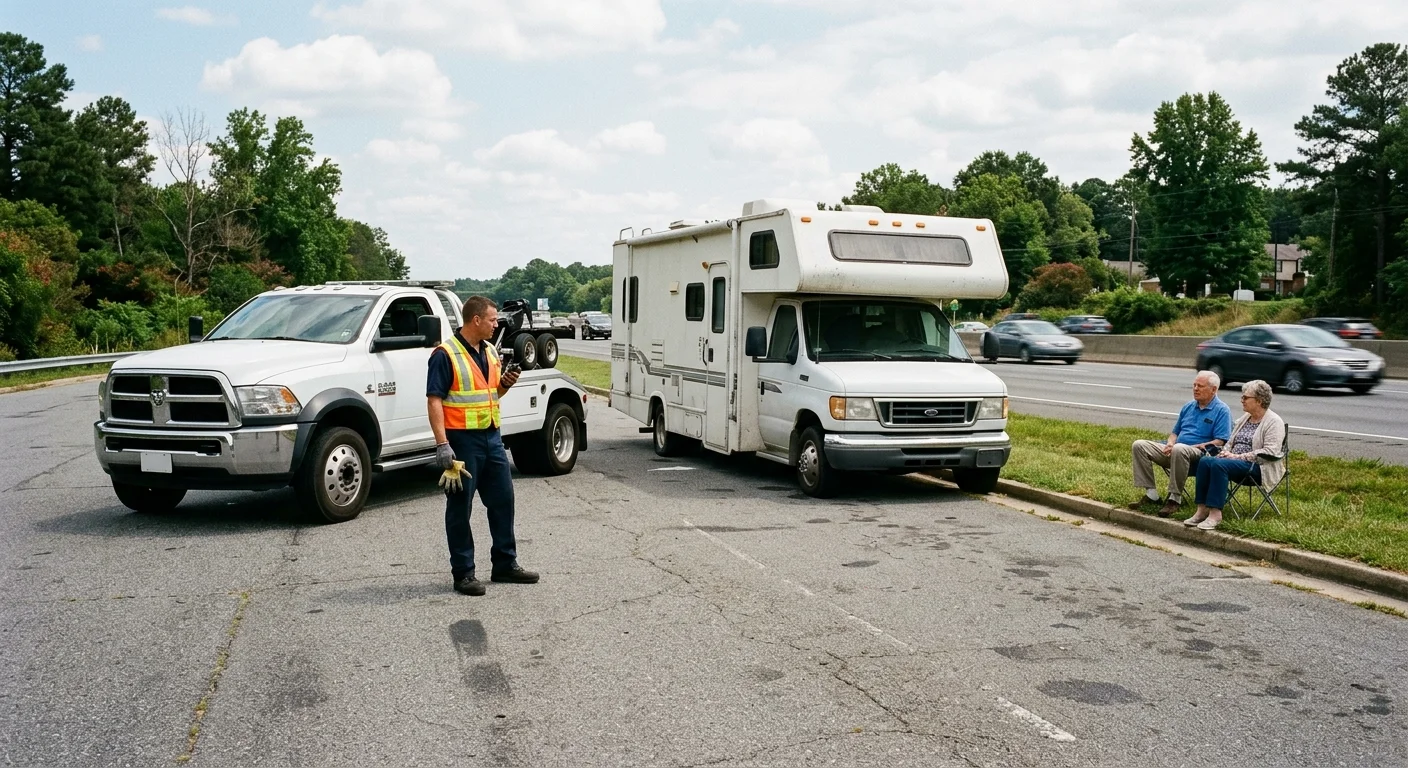
A blowout on a motorhome or travel trailer around Richmond is a scene problem first and a service problem second. RV tire blowout towing is the right request when the wheel, fender, or coach body is torn, or the rig cannot roll on the remaining tires. Get everyone out of the travel lanes, then tell a licensed operator what you see so they can send roadside assistance or an RV recovery truck.
Move people away from traffic risk first
Get people out of the path of traffic before you look at the tire. Put the hazards on. If you have a shoulder, a gore, or a wide paved pad, use it. Then move everyone, including pets, well off the pavement or behind a barrier. Do not stand at the rear corner of the coach with your back to live lanes.
That matters more on some Richmond roads than others. The I-95/I-64 overlap through downtown, from the Bryan Park interchange south to the James River, is described in a VDOT overlap study as “one of the highest crash, heavily congested corridors in the region.” Shoulders there are tight. Trucks stack up. A motorhome sitting half in a lane is a second crash waiting. South of town on I-95 through Chester and Colonial Heights, the pavement is often wider, but through-traffic is faster. Same rule: people first, photos later.
Turn on flashers so other drivers can see you. On a highway with four or more lanes, Virginia’s move-over law requires drivers approaching a stationary vehicle with flashing amber lights, hazard flashers, or emergency lights to change lanes away from you, or to slow down if a lane change is not safe. That only helps if they can see you.
Do not walk into the travel lane to pick up tire belt. Do not crawl under the coach. If anyone is hurt, call 911 first. If you are on I-95, I-64, or I-295, VDOT’s Safety Service Patrol may already be working that corridor. SSP is free roadside help. They can control the scene, move debris, and help you arrange a tow. They do not act as a tow company, and they do not do mechanical repairs. Daytime coverage on those Richmond routes runs from 5:00 a.m. to 9:00 p.m. There is also an overnight I-95 route between the I-295 interchange (mile 84) in Hanover County and Route 10 (mile 61) in Chester. Check live conditions on 511 Virginia.
Report the RV and tire location
“I-95 near Richmond” is not a location. Say northbound or southbound, the nearest mile marker or exit, and which locality you are actually in. A coach stopped at Chester is a different recovery than one in the Fan, on I-64 west toward Short Pump, or on I-85 down at Petersburg. I-295, Route 10, and the downtown overlap all change how far a recovery truck has to run and how much room it has to work.
If you are in a lot, name the lot and the entrance. Midlothian Turnpike, a campground spur, a Raceway weekend overflow lot on Laburnum, and a Kings Dominion exit up at Doswell are not the same job. Say whether this is a motorhome you were driving or a trailer still hitched to a truck. Say if slide-outs are out, if you are blocking a lane, and if you already spoke with 911 or SSP.
Call 911 if you are in a travel lane or anyone is injured. For a parked, stable scene, the next useful call is the one that matches you with a licensed operator. Quick Tow Richmond is a referral line, not a tow company. The line takes calls 24/7. A recording notice plays before you leave a message. No one answers live, so put the location in the first sentence: direction, road, mile marker or exit, city or county, motorhome or trailer, and whether you are fully off the pavement.
If you were heading through the Tri-Cities when the tire went, the same facts matter there. A camper that cannot roll in Colonial Heights still needs a clear pin on I-95, I-85, or a local connector, not a vague “south of Richmond.”
Describe visible wheel or body damage
The operator needs a picture in words, not a guess about what failed inside the tire. From a safe spot, walk the side that is away from traffic. Say which corner failed. Say whether the tire is shredded, still on the rim, or gone. Say whether the wheel is still attached, bent, or sitting on the drum. Say whether the fender, skirt, underbelly, or wiring looks torn.
A travel-trailer blowout often throws rubber into the wheel well and can cut the next tire or the fresh-water and sewer lines that run along that side. A motorhome with dual rear wheels can hide an inner-dual failure until you walk around. None of that is a reason to start the engine and “see if it drives.” It is a reason to say what you can see without crawling under the coach.
Do not treat a quiet tire as a good tire. A sidewall can be sliced while the coach is still sitting level. If you can take a photo from behind a barrier, do that. If you cannot, skip it. A description is enough: left rear, tire gone, aluminum wheel scored, fiberglass chewed for about a foot, no fluid on the pavement.
That damage report is what separates a spare-tire call from a tow. Roadside help only makes sense if the wheel and body still look whole. Once the fender is folded into the tire, or the coach is sitting on a rim, the operators we connect you with are towing, not swapping a wheel in a live lane.
Explain whether the RV can roll
Say whether the rig can move a few feet under its own power, or whether a wheel is locked, an axle is down, or the frame is on the drum. “It steers and the other tires are up” is useful. “It will not roll, and the blown corner is grinding” is also useful. Those are different trucks and different setups.
Do not try to nurse a destroyed tire to the next ramp. The remaining tires are already carrying extra load. We do not have a verified number for how much extra they can take, so do not assume they can. If you are towing a trailer, do not unhitch in a travel lane to “make it easier.” Stay coupled until a licensed operator is on scene and can control the rig.
Tell them the approximate length and what you are sitting in: Class A, Class C, fifth-wheel, or bumper-pull. Tell them if you know a destination, even if it is only “the campground in Chester” or “a shop off Midlothian.” Mileage is one of the things that moves the bill. So is a rig that will not roll, a lane that has to be cleared, and work after dark. Ask for the full total with mileage before you agree. Quick Tow does not set the operator’s price. For what tends to move an RV bill in this metro, read RV and motorhome towing cost in Richmond.
A coach that can creep onto a wider shoulder in Hanover is a different job than a trailer sitting on a rim in a Colonial Heights gore. Say which one you are.
Confirm roadside help or RV tire blowout towing before dispatch
Confirm the job type before anyone rolls. Roadside help is only in play if you are fully off the roadway, the wheel and body look intact, and you have a matching spare that a licensed tech can mount in a safe spot. Even then, a motorhome tire is not a passenger-car spare swap. Do not count on a small service truck until the operator says that truck can actually do this tire.
Choose a tow when any of this is true: the wheel or fender is torn, the coach is on a rim, you have no safe spare, a dual has failed, the trailer will not track, or you are blocking a lane. That is the common Richmond-metro outcome on I-95 and I-64, especially after a high-speed failure. SSP can help you get clear and help you arrange the tow. They will not haul the coach to a shop.
Be honest about hitch and body damage. A camper that blew a tire and then slapped the fender into the sidewall is the same family of job as a camper trailer that broke down in Colonial Heights: the operator needs to know it may not roll, and that the tow vehicle and trailer may have to travel as a unit.
Do not agree to “send someone” without hearing whether that someone is roadside or recovery. The brand matches you with independent licensed operators. They contract with you and bill you. Ask what they are sending, whether the RV must roll, and the total with mileage, then stay out of traffic until they arrive.
Frequently asked questions
What causes an RV tire blowout?
Heat, load, age, and road damage are the usual mix. Underinflation lets the sidewall flex until it fails. Extra weight and long runs on I-95 or I-64 add heat. Old rubber can look fine in a driveway and still come apart. A pothole or debris hit can bruise a tire that fails miles later. This site does not publish tire-pressure specs or load ratings. Use the numbers on your tire and your coach’s own plate.
What should you do if a trailer tire blows?
Hold a straight line until you can get the trailer fully out of the travel lane, then stop. Get people away from traffic. Do not walk the interstate to collect rubber. Do not unhitch in a live lane. Describe the corner, the wheel, and any body damage, then ask for roadside help or a tow. If you are on I-95, I-64, or I-295, SSP may reach you first and help you arrange the paid recovery.
Can you drive a trailer with a blown tire?
No. Do not drive on the destroyed tire, and do not assume the other tires can carry the extra load to the next exit. If the trailer cannot roll safely, say so and wait for a recovery. A short creep onto a wider shoulder is only for getting out of a lane, not for finishing the trip.
Will insurance cover a tire blowout or the tow?
That is a policy question, not a Virginia-law question. Towing and roadside coverage is an optional add-on here. It is not a mandated coverage. Liability and uninsured/underinsured motorist are the required lines. Ask your carrier what your policy pays for the tire, the body damage, and the tow. Our longer explainer is does insurance cover towing in Virginia.
When to call us
Call when a blown RV tire has left you on a Richmond-metro shoulder, ramp, or lot and you need a licensed operator to decide roadside help versus a recovery. The line takes calls 24/7. Call us at (804) 701-6752.